
KPV Peptide: Why This Tiny Peptide Is Getting Attention for Gut & Inflammation Research
Three amino acids have opened compelling research questions about inflammatory signaling, intestinal biology and immune communication—but the evidence remains preclinical.
Key takeaways
- KPV is a three-amino-acid peptide—lysine, proline and valine—from the C-terminal end of α-MSH.
- Cell and animal studies have investigated KPV in connection with NF-κB, MAPK, PepT1 and intestinal inflammatory signaling.
- FDA's 2026 review reported no identified clinical studies or human exposure data for administered KPV by any route.
- KLOW generally combines KPV, GHK-Cu, BPC-157 and TB-500, but controlled evidence for the blend itself has not been established.
- BALANCE features KPV, NAD+ and GHK-Cu in LavION's needle-free wearable platform; it is not KLOW.
Inflammation isn't the enemy. It is one of the body's most important defense systems, helping coordinate the response to injury, infection and other threats.
The concern is what can happen when inflammatory signaling becomes excessive, prolonged or poorly regulated. That is where an unusually small peptide has attracted researchers' attention: KPV.
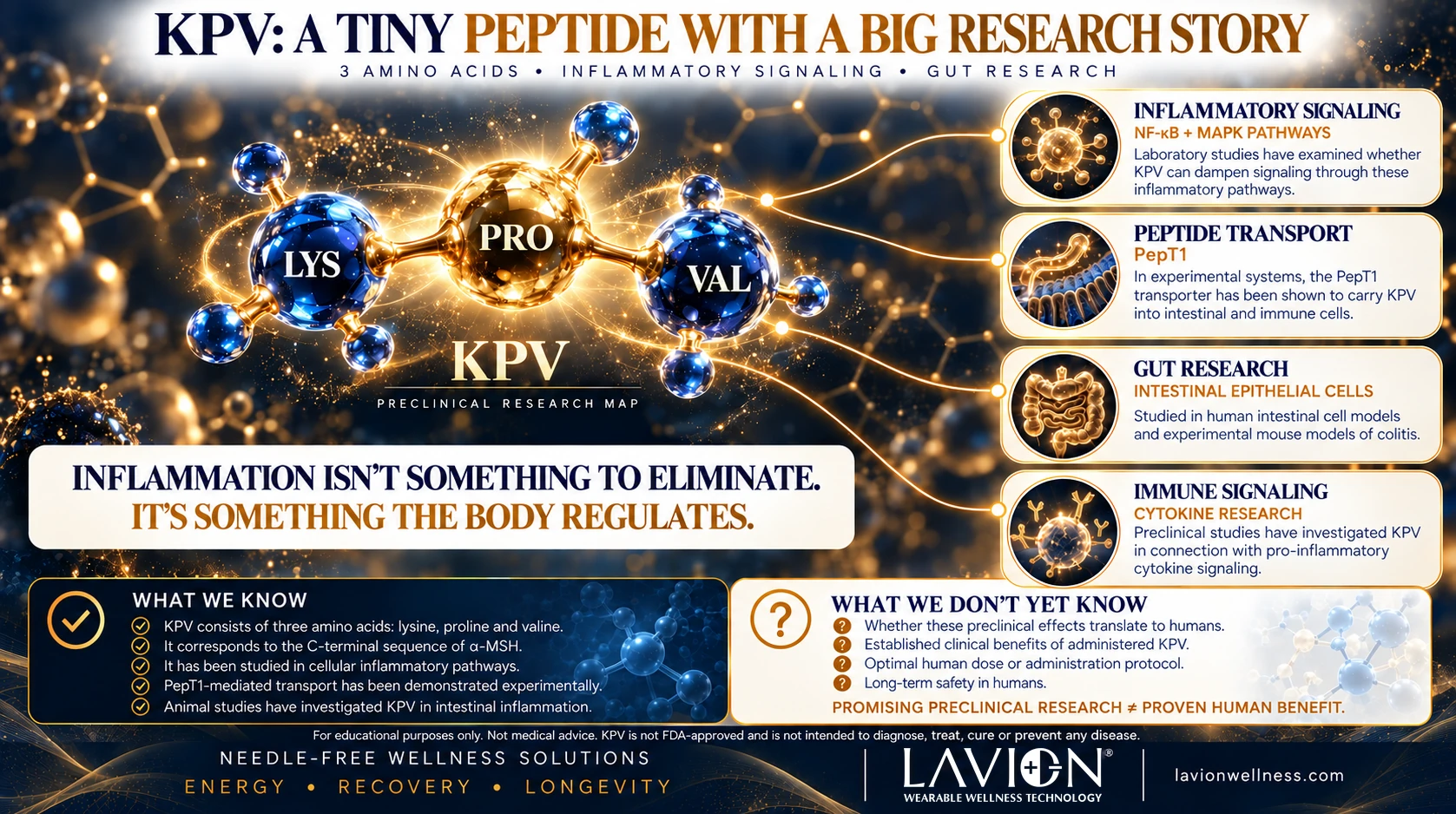
KPV contains just three amino acids—lysine, proline and valine. Despite its size, researchers have investigated it in cellular and animal models involving inflammatory signaling, intestinal inflammation, immune responses and skin biology. Reported mechanisms involve pathways including NF-κB, MAPK and inflammatory cytokines.
What Is KPV Peptide?
KPV stands for lysine (K), proline (P) and valine (V). Together, those amino acids form a tripeptide corresponding to amino acids 11–13 at the C-terminal end of alpha-melanocyte-stimulating hormone, or α-MSH.
α-MSH is a naturally occurring 13-amino-acid peptide derived from POMC and has been studied for roles involving pigmentation, inflammatory responses and immune signaling. Researchers became interested in KPV because this fragment retained anti-inflammatory activity in experimental models without the pigmentary activity associated with α-MSH. [3] [4]
Why Are Researchers Interested in KPV?
Inflammation is not one switch that turns on or off. It is a complex network of cells, transcription factors and chemical messengers. KPV research touches several parts of that network.
1. Inflammatory Signaling
NF-κB is a family of transcription factors involved in regulating genes associated with inflammation, immune responses and other cellular processes. MAPK is another important family of signaling pathways.
In experiments using human intestinal epithelial and immune cell lines, KPV exposure reduced activation of NF-κB and MAPK pathways and reduced secretion of certain pro-inflammatory cytokines under the experimental conditions. [1]
2. Gut & Intestinal Research
PepT1 helps transport small peptides across cell membranes and plays a role in absorbing dipeptides and tripeptides in the small intestine. Experimental research found that KPV can be transported into intestinal epithelial and immune cells through PepT1.
Investigators also tested KPV in experimentally induced mouse models of colitis and reported reductions in measures of intestinal inflammation and pro-inflammatory cytokine expression. A separate mouse study reported improvements in several experimental measures of intestinal inflammation. [1] [2]
Those findings explain why KPV and gut health are increasingly discussed together. They do not establish KPV as a treatment for inflammatory bowel disease, Crohn's disease or ulcerative colitis in people.
3. Immune Signaling & Cytokines
Cytokines are signaling proteins that cells use to communicate. KPV studies have measured signaling involving IL-1β, IL-8, TNF-α and other inflammatory mediators, depending on the model. Several preclinical experiments found changes in inflammatory signaling or cytokine production. [1] [2]
Cytokines are not inherently bad. Like inflammation itself, they are part of normal immune biology. The scientific interest is in regulation—not eliminating inflammatory signaling.
4. Skin & Wound Research
Because KPV comes from α-MSH, researchers have also explored melanocortin-related peptides in keratinocytes, animal models and cutaneous wound-healing research. [4]
An early laboratory study also reported antimicrobial activity of α-MSH and KPV against Staphylococcus aureus and Candida albicans under experimental conditions. That does not establish KPV as a treatment for wounds, infections or skin conditions in humans. [5]
The α-MSH Connection
At the end of α-MSH's 13-amino-acid sequence sit lysine, proline and valine. Researchers found that this tiny C-terminal sequence retained activity in experimental inflammatory models despite lacking the full structure of α-MSH. [3]
Research suggests KPV's effects may not depend on the same classical melanocortin receptor mechanisms associated with the full α-MSH molecule. Experiments have instead investigated PepT1-mediated uptake and intracellular inflammatory signaling. [1]
What Is the KLOW Peptide Blend?
KLOW is not one peptide. It is a name used for a multi-component research blend generally combining KPV + GHK-Cu + BPC-157 + TB-500. It is not a standardized pharmaceutical formulation, and formulations can vary.
| Component | Research interest |
|---|---|
| KPV | Inflammatory and intestinal signaling |
| GHK-Cu | Skin, extracellular matrix and cellular biology |
| BPC-157 | Primarily preclinical tissue and gastrointestinal research |
| TB-500 / thymosin beta-4 | Cellular migration, actin biology and tissue-repair mechanisms |
The individual ingredients have separate bodies of research. We did not identify a controlled published study evaluating all four together as the KLOW combination. Research on four individual compounds does not prove that combining them produces additive, complementary or synergistic effects.
Is KPV an Anti-Inflammatory Peptide?
KPV has demonstrated anti-inflammatory activity in cellular and animal models. [1] [2] [3] What has not been established is that administering KPV produces clinically meaningful anti-inflammatory effects in humans.
The scientifically careful statement is: KPV is being studied for its effects on inflammatory signaling. That is different from claiming that KPV reduces inflammation in people.
What Does the Human Evidence Actually Show?
In its 2026 scientific review, FDA reported that the nomination included no clinical studies or human exposure data for KPV and that the agency identified no human exposure data by any route. Potential safety, immunogenicity and aggregation risks in humans therefore remain unknown. [6]
In July 2026, FDA's Pharmacy Compounding Advisory Committee considered KPV free base and KPV acetate for potential inclusion on the 503A Bulks List. The committee voted 8–6, with one abstention, to recommend potential inclusion—differing from FDA staff's recommendation. The vote was advisory, not FDA approval, and did not establish safety or effectiveness for any condition. [6]
KPV Research vs. KPV Hype
| What research supports | What has not been established in humans |
|---|---|
| A tripeptide made of lysine, proline and valine | Treatment for IBD, Crohn's disease or ulcerative colitis |
| The C-terminal sequence of α-MSH | Gut healing or treatment of autoimmune disease |
| Activity in laboratory experiments | Treatment for skin disease, wounds or infection |
| Research involving NF-κB, MAPK and PepT1 | Elimination of systemic inflammation |
| Animal models of intestinal inflammation | Improved recovery or established clinical benefit |
| Preclinical skin and immune research | An established human dose or delivery protocol |
The science is interesting enough without turning early research into promises.
Does KPV Have to Be Injected?
Peptide biology and peptide delivery are separate scientific questions. KPV research has used oral, topical and specialized delivery approaches in preclinical models. Evidence from one method should not automatically be assumed to apply to another—including transdermal delivery.
For a broader comparison, read peptide therapy without injections and transdermal vs. injectable peptides.
A Different Approach to Peptide Delivery
LavION is not a traditional passive wellness patch. Its wearable incorporates iontophoresis technology, a sealed power source and two electrodes. Iontophoresis uses a mild electrical current to assist the movement of charged molecules across the skin.
The LavION wearable is designed for a 12-hour wear period. Preclinical research involving injected, oral or other forms of KPV should not automatically be interpreted as evidence for transdermal KPV; each delivery method needs its own evaluation. Not a sticker. A device. See how LavION works →
Meet BALANCE: Featuring KPV
The Bottom Line
KPV is tiny—just three amino acids—but laboratory and animal research has opened compelling questions about inflammatory signaling, intestinal biology, immune communication and skin research.
The growing popularity of KLOW has brought more attention to KPV. But popularity and evidence are not the same. We do not yet have human clinical evidence for administered KPV, or controlled evidence showing what happens when the four KLOW components are studied together.
That does not make the underlying research meaningless. It tells us what stage the science is in: three amino acids, a fascinating research story and a lot left to learn.
At LavION, we believe emerging science is most interesting when it is explained accurately. Explore related research on MOTS-c, glutathione, and peptides for pain management.
References
- 1.Dalmasso G, et al. “PepT1-mediated tripeptide KPV uptake reduces intestinal inflammation.” Gastroenterology. 2008;134(1):166–178. View on PubMed
- 2.Kannengiesser K, et al. “Melanocortin-derived tripeptide KPV has anti-inflammatory potential in murine models of inflammatory bowel disease.” Inflammatory Bowel Diseases. 2008;14(3):324–331. View on PubMed
- 3.Getting SJ, et al. “Dissection of the anti-inflammatory effect of the core and C-terminal (KPV) α-melanocyte-stimulating hormone peptides.” Journal of Pharmacology and Experimental Therapeutics. 2003. View on PubMed
- 4.Brzoska T, et al. “Alpha-melanocyte-stimulating hormone and related tripeptides.” Endocrine Reviews. 2008. View on PubMed
- 5.Cutuli M, et al. “Antimicrobial effects of alpha-MSH peptides.” Journal of Leukocyte Biology. 2000;67(2):233–239. View on PubMed
- 6.U.S. Food and Drug Administration. Pharmacy Compounding Advisory Committee, July 23–24, 2026. View FDA meeting materials
Frequently asked questions
What is KPV peptide?
KPV is a tripeptide made from lysine, proline and valine. It corresponds to the C-terminal three-amino-acid sequence of alpha-melanocyte-stimulating hormone, or α-MSH.
What does KPV stand for?
KPV represents the one-letter amino-acid abbreviations for lysine (K), proline (P) and valine (V).
What are the benefits of KPV?
KPV has demonstrated biological effects involving inflammatory signaling in cell and animal studies. Human clinical benefits from administered KPV have not been established.
Is KPV anti-inflammatory?
KPV has demonstrated anti-inflammatory activity in preclinical experiments involving NF-κB, MAPK and cytokine signaling. That does not establish it as a clinically proven anti-inflammatory treatment in humans.
Is KPV good for gut health?
KPV has been studied in intestinal epithelial cells and animal models of intestinal inflammation. Clinical benefits for human gut health have not been established.
What is PepT1?
PepT1 is a transporter involved in moving small peptides across cell membranes. Experimental research has shown PepT1-mediated uptake of KPV in intestinal epithelial and immune cells.
What is KLOW peptide?
KLOW generally refers to a research blend containing KPV, GHK-Cu, BPC-157 and TB-500. It is not a single peptide or standardized pharmaceutical formulation, and formulations can vary.
What is the difference between KPV and KLOW?
KPV is an individual three-amino-acid peptide. KLOW is a research-blend designation generally used for KPV, GHK-Cu, BPC-157 and TB-500 together.
Has the KLOW peptide blend been studied?
Its components have separate research literature, but we did not identify a controlled published study evaluating the four-component KLOW blend itself.
What is the relationship between KPV and α-MSH?
KPV is the three-amino-acid C-terminal sequence of α-MSH. Experimental research found that it retains biological activity while lacking α-MSH's pigmentary activity.
Does KPV treat IBD?
KPV has been investigated in mouse models of colitis but has not been established as a treatment for inflammatory bowel disease in humans.
Has KPV been studied in humans?
FDA's 2026 scientific review reported no identified clinical studies or human exposure data for administered KPV by any route.
Is KPV FDA approved?
No. A 2026 advisory committee recommendation concerning possible 503A Bulks List inclusion was non-binding and is not FDA approval of a drug.
Keep reading
This article offers general wellness education and does not replace medical advice. Statements about LavION+ products have not been evaluated by the FDA, and these products are not intended to diagnose, treat, cure, or prevent disease. Peptide orders include a clinician review before fulfillment. If you are pregnant, nursing, managing a condition, or taking medication, speak with your clinician. See our medical disclaimer.