
Peptides for Pain Management: BPC-157, TB-500 & GHK-Cu Explained
What if the conversation around pain wasn't only about blocking the pain signal? Here is what research on BPC-157, TB-500 and GHK-Cu actually shows — and where human evidence is still limited.
Key takeaways
- Pain isn't one biological process — it can involve inflammation, tissue stress, connective-tissue damage and nerve signaling.
- BPC-157, TB-500 and GHK-Cu are studied in connection with different pathways: tissue repair, cell migration, angiogenesis, collagen and inflammatory signaling.
- A 2025 systematic review found 36 BPC-157 studies in orthopaedic sports medicine — 35 preclinical, only one in humans.
- None of these peptides is an established treatment for chronic pain. “Being studied” is not “clinically proven.”
- Peptides don't have to mean injections — LavION uses a wearable iontophoresis platform with a 12-hour wear period.
Pain can be complicated. A sore shoulder, aching knee or stubborn tendon may involve inflammation, tissue stress, connective-tissue damage, nerve signaling and the body's own recovery response.
That's one reason peptides have become such a major topic in conversations surrounding pain management and recovery. Rather than simply looking at how pain is perceived, researchers are investigating whether certain peptides interact with biological processes involved in inflammation, tissue repair, blood-vessel formation, collagen production and recovery.
Three names frequently come up: BPC-157. TB-500. GHK-Cu. Each is different, each has been studied in connection with different biological pathways — and while the research is intriguing, it's important to understand what the science actually shows, and where human evidence is still limited.
What Are Peptides?
Peptides are short chains of amino acids — the same basic building blocks that make up proteins. An easy way to think about them is as biological messengers.
Different peptides have different sequences, and those sequences can interact with different processes in the body. That's why “peptides” aren't really one thing. One peptide may be studied in connection with collagen production, while another may be investigated for cell migration, inflammatory signaling or tissue repair.
In pain and recovery research, scientists are particularly interested in:
- Tissue repair
- Collagen production
- Angiogenesis
- Cell migration
- Inflammatory signaling
- Muscle, tendon and ligament recovery
Why Are Peptides Being Studied in Pain Management?
Depending on the cause, pain may involve injured tissue, inflammation, changes within a joint, irritated nerves, damaged connective tissue or other underlying conditions. That's why pain relief and tissue recovery aren't necessarily the same thing.
A medication can change how strongly someone perceives pain without repairing injured tissue. Likewise, something involved in tissue-repair pathways shouldn't automatically be described as a pain reliever. Here are four areas getting particular attention.
1. Blood Flow & Angiogenesis
Healing tissue needs oxygen and nutrients. Angiogenesis is the process through which new blood vessels form from existing vessels. BPC-157 has been investigated in preclinical research involving angiogenesis and vascular pathways, and thymosin beta-4 research has also explored blood-vessel development.
This doesn't mean these peptides have been clinically proven to heal injuries or relieve pain in humans — but it helps explain why angiogenesis appears so frequently in peptide research.
2. Tissue Repair & Cell Migration
When tissue is injured, repair requires cells to communicate, move and participate in rebuilding the affected area. BPC-157 has been investigated in preclinical models involving muscle, tendon, ligament, bone and gastrointestinal tissue. Thymosin beta-4 has been researched for its involvement in cell migration, wound repair and tissue regeneration. Much of this research is preclinical.
3. Inflammatory Signaling
Inflammation isn't automatically bad — short-term inflammation is part of the body's normal response to injury. Persistent or dysregulated inflammation, however, can be associated with many painful conditions.
Researchers have investigated BPC-157, thymosin beta-4 and GHK-Cu in connection with various inflammatory and oxidative-stress pathways. That does not mean these peptides are proven anti-inflammatory treatments. Persistent or unexplained pain should always be evaluated by a qualified healthcare professional.
4. Collagen & Connective Tissue
Collagen provides structural support throughout the body — tendons, ligaments, cartilage, skin and connective tissue. This is where GHK-Cu becomes particularly interesting: a naturally occurring copper-binding peptide researched since the 1970s for collagen synthesis, tissue remodeling, wound healing, antioxidant activity and skin regeneration.
GHK-Cu is best known in skin care, but collagen isn't only about skin — which is why it's relevant to broader conversations about tissue health. See our full GHK-Cu guide.
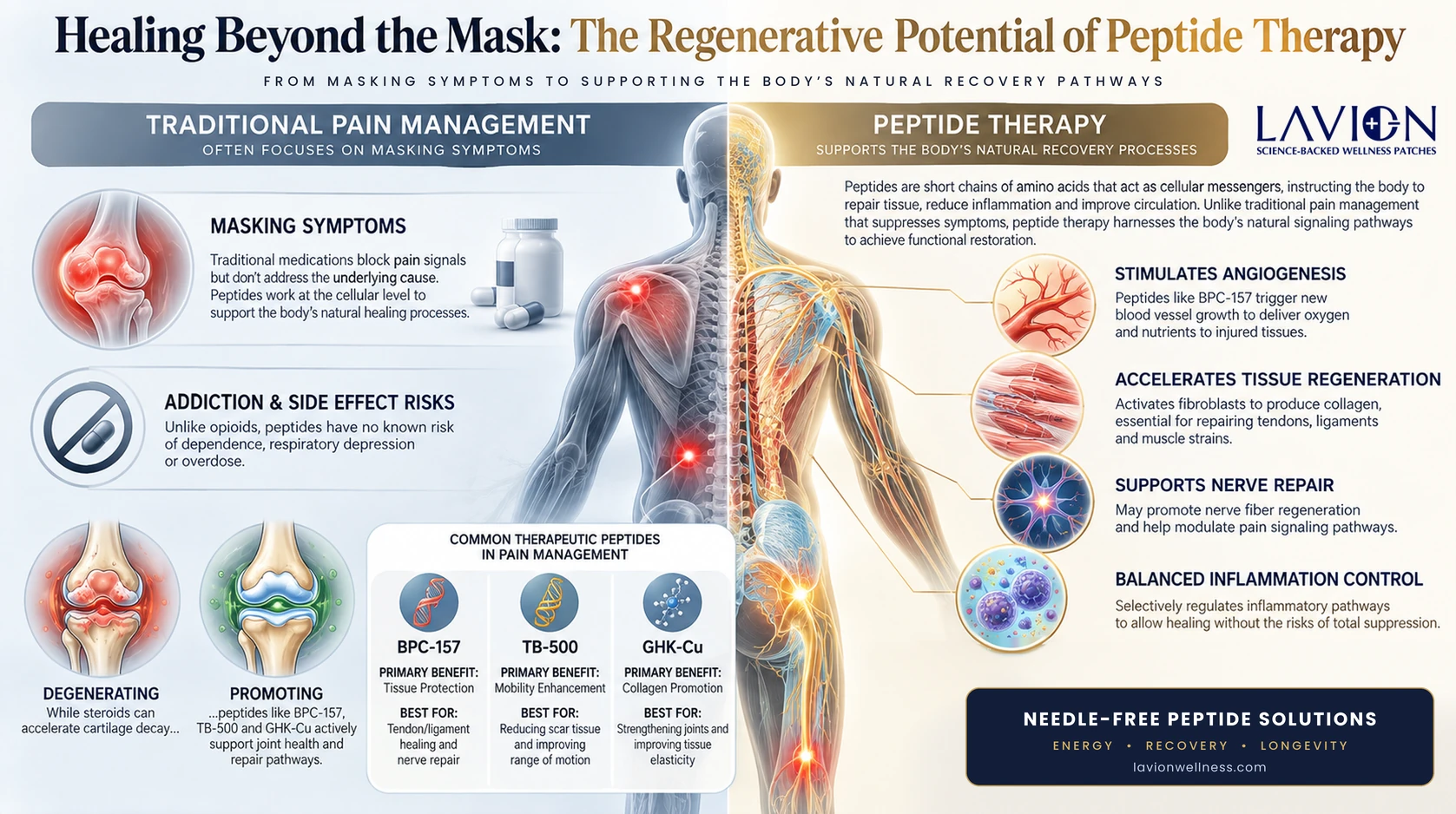
Three Peptides Getting Attention
BPC-157: Tissue + Repair Research
BPC-157 is a synthetic 15-amino-acid peptide popular in sports medicine, recovery and regenerative-medicine conversations. Preclinical research has explored:
- Tendon and ligament repair
- Muscle recovery
- Angiogenesis
- Fibroblast activity
- Collagen-related processes
- Inflammatory signaling
TB-500: Mobility + Recovery Research
TB-500 and thymosin beta-4 are sometimes used interchangeably, but they aren't necessarily the same thing. Thymosin beta-4 is a naturally occurring peptide researched for cell migration, angiogenesis, wound repair, tissue remodeling and inflammatory processes. TB-500 generally refers to a synthetic thymosin beta-4-related peptide or fragment.
This matters because research on full thymosin beta-4 shouldn't automatically be treated as clinical evidence for every product described as TB-500. Human evidence specifically involving TB-500 remains limited.
GHK-Cu: Collagen + Connective-Tissue Research
Unlike BPC-157 and TB-500, many consumers already know GHK-Cu from skin and healthy-aging conversations. Researchers have investigated it for collagen synthesis, tissue remodeling, wound healing, antioxidant activity, skin regeneration and inflammatory processes — adding another dimension to the peptide-and-recovery conversation.
Why Are BPC-157, TB-500 & GHK-Cu Discussed Together?
Because they aren't all doing the same thing. BPC-157 research focuses heavily on tissue-repair and vascular pathways. Thymosin beta-4 research explores cell migration, angiogenesis and wound repair. GHK-Cu brings collagen synthesis, tissue remodeling and antioxidant pathways.
Different peptides can interact with different biological pathways involved in recovery. That doesn't mean combining them has been clinically proven to relieve chronic pain or accelerate healing. Learn more in What Is the Wolverine Stack? and Wolverine Stack vs TITAN.
Can Peptides Treat Chronic Pain?
This is where we think transparency matters. BPC-157, TB-500 and GHK-Cu should not be presented as established treatments for chronic pain. Much of the evidence for BPC-157 and TB-500 comes from laboratory and animal research, and human evidence remains limited.
That doesn't make the research unimportant. But “researchers are studying this” and “this has been clinically proven to treat pain” aren't the same thing. Consumers deserve to understand both the possibilities and the limitations of emerging peptide science.
Do Peptides Have to Mean Injections?
Peptides have become closely associated with injection-based routines — needles, preparation, storage and frequent administration. That's one reason we created LavION. Compare the options in Transdermal vs Injectable Peptides.
LavION is not a traditional passive wellness patch. Our wearable incorporates iontophoresis technology with a microchip, a sealed power source and two electrodes. Iontophoresis uses a mild electrical current to assist the movement of charged molecules across the skin, over a 12-hour wear period. Not a sticker. A device. See how LavION works →
Where These Peptides Show Up in LavION
| Formula | Ingredients | Focus |
|---|---|---|
| TITAN | BPC-157 2mg • TB-500 10mg • NAD+ 250mg • GHK-Cu 5mg | Two of the most talked-about peptides in recovery research, in a needle-free 12-hour wearable. |
| GLOW | GHK-Cu 15mg • BPC-157 2mg • TB-500 2mg • NAD+ 250mg | Brings GHK-Cu collagen and tissue-remodeling research into a goal-based wellness formula. |
Interested in Peptides — Not the Injections?
Peptide science is evolving quickly, and so is the way consumers access wellness. LavION was built around a simple idea: what if incorporating peptides into your routine didn't have to revolve around needles? Needle-free peptide solutions for energy, recovery and longevity. Explore LavION →
References
Vasireddi N, et al. “Emerging Use of BPC-157 in Orthopaedic Sports Medicine: A Systematic Review.” HSS Journal, 2025. View the systematic review
Frequently asked questions
What peptides are being studied for pain and recovery?
BPC-157, thymosin beta-4-related peptides and GHK-Cu are among the peptides being researched in connection with biological processes relevant to tissue repair, collagen production, inflammation and recovery. The amount and quality of evidence varies considerably by peptide.
Is BPC-157 proven to relieve pain?
No. BPC-157 has substantial preclinical research and limited human data, but there is not currently enough high-quality human clinical evidence to establish BPC-157 as a treatment for chronic pain.
What is TB-500?
TB-500 generally refers to a synthetic thymosin beta-4-related peptide or fragment. Thymosin beta-4 has been researched in connection with cell migration, angiogenesis and wound-repair processes, but research on thymosin beta-4 should not automatically be interpreted as evidence for TB-500.
What is GHK-Cu?
GHK-Cu is a naturally occurring copper-binding peptide that has been studied in connection with collagen synthesis, tissue remodeling, antioxidant activity, wound healing and skin regeneration.
Why are BPC-157 and TB-500 often discussed together?
Research involving BPC-157 and thymosin beta-4-related peptides touches on different but sometimes overlapping biological processes associated with tissue repair and recovery. This is one reason they are frequently discussed together. Their combination has not been established as a treatment for chronic pain.
Do peptides have to be injected?
Peptides are frequently associated with injections, but delivery methods vary. LavION uses a wearable iontophoresis platform rather than a traditional injection-based routine.
Can peptides replace medical treatment for chronic pain?
No. BPC-157 and TB-500 are not established replacements for conventional medical treatment. Persistent, worsening or unexplained pain should be evaluated by a qualified healthcare professional.
Keep reading
This article offers general wellness education and does not replace medical advice. Statements about LavION+ products have not been evaluated by the FDA, and these products are not intended to diagnose, treat, cure, or prevent disease. Peptide orders include a clinician review before fulfillment. If you are pregnant, nursing, managing a condition, or taking medication, speak with your clinician. See our medical disclaimer.