
MOTS-c Explained: The Mitochondrial Peptide Being Studied for Energy, Metabolism & Healthy Aging
What if your mitochondria do more than make energy? Researchers are studying MOTS-c as a messenger involved in metabolic signaling, exercise, cellular stress and aging.
Key takeaways
- MOTS-c is a naturally occurring 16-amino-acid mitochondrial-derived peptide encoded within mitochondrial DNA.
- Researchers are studying its relationship to metabolic signaling, AMPK, exercise, cellular stress and aging.
- Human studies have measured naturally occurring MOTS-c, but evidence for administered MOTS-c in people remains extremely limited.
- MOTS-c has not been established as a treatment for weight loss, fatigue, diabetes, athletic performance or aging.
- LavION IGNITE incorporates MOTS-c into a needle-free, 12-hour wearable iontophoresis platform.
Most of us learned that mitochondria are the “powerhouses” of our cells—the tiny structures responsible for helping turn nutrients into usable cellular energy.
But researchers now understand that mitochondria do much more. They also communicate.
One of the most intriguing discoveries in this emerging field is MOTS-c, a small peptide encoded within mitochondrial DNA. Unlike many peptides that have become popular in wellness and recovery conversations, MOTS-c originates from the mitochondria themselves. Researchers are studying it in connection with metabolic signaling, cellular stress, exercise and aging.
The research is fascinating. But it is also important to understand what scientists have actually demonstrated—and what remains unknown.
What Is MOTS-c?
MOTS-c stands for mitochondrial open reading frame of the 12S rRNA type-c. It is a naturally occurring 16-amino-acid mitochondrial-derived peptide encoded within the mitochondrial 12S ribosomal RNA gene.
That is what makes MOTS-c particularly unusual. Most of the proteins and peptides involved in cellular function are associated with genetic instructions from the cell's nucleus. MOTS-c comes from genetic information within the mitochondria.
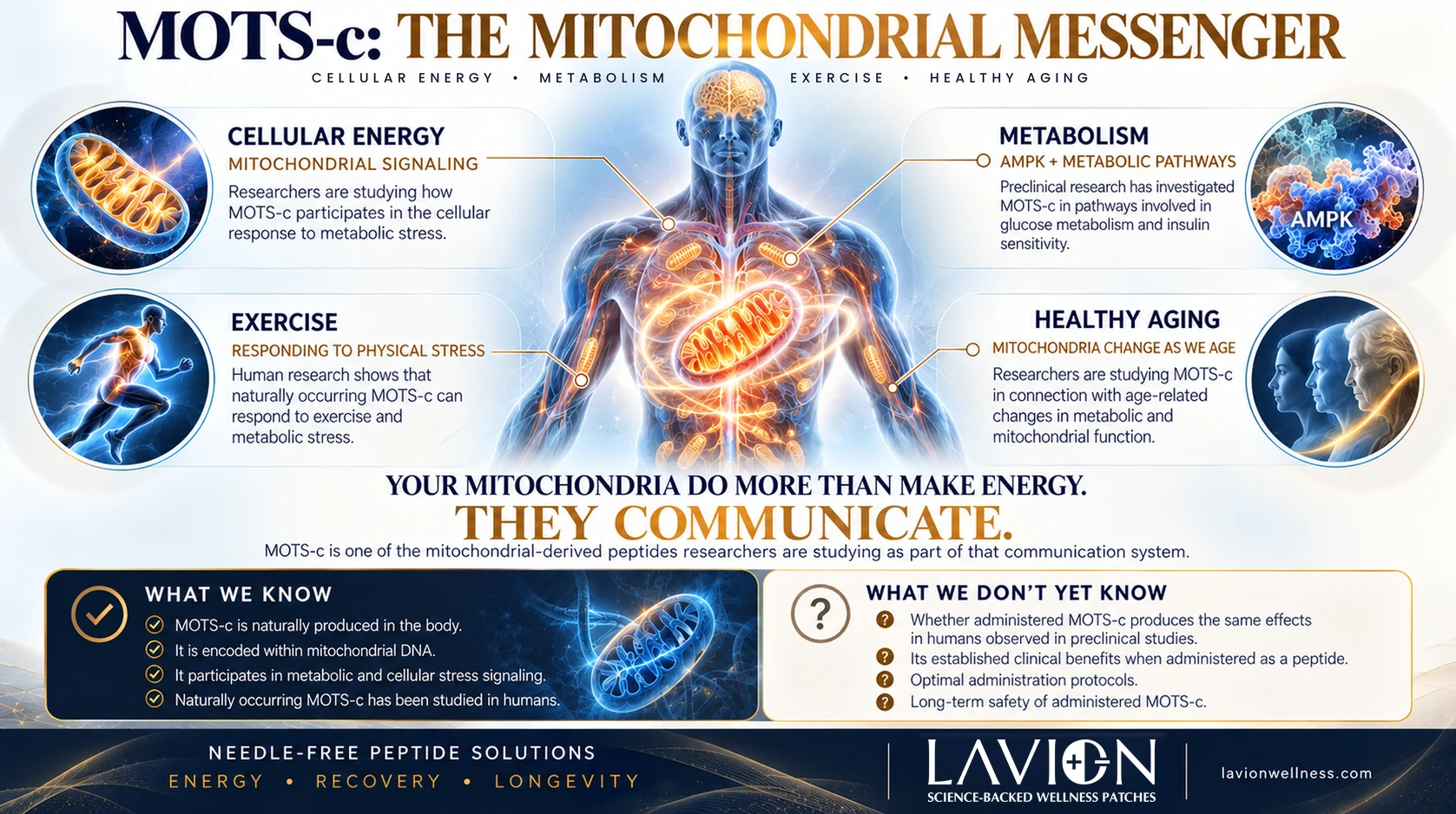
Researchers increasingly view mitochondrial-derived peptides like MOTS-c as part of a communication system through which mitochondria can respond to metabolic stress and send signals affecting cellular activity. In other words: your mitochondria do not just make energy. They communicate. MOTS-c appears to be one of the messengers researchers are studying.
Why Are Researchers So Interested in MOTS-c?
MOTS-c sits at the intersection of several topics receiving enormous attention in health and longevity research: mitochondria, metabolism, exercise, cellular stress and aging.
Its role appears to involve mitochondrial retrograde signaling. The concept is relatively simple: cells need a way for mitochondria to communicate information about what is happening inside them. When cells encounter stress—such as changes in energy availability or physical activity—mitochondria participate in signaling pathways that help the cell respond. MOTS-c is being investigated as one component of that communication network.
Four Areas of MOTS-c Research
1. Cellular Energy & Metabolic Stress
Mitochondria are central to cellular energy production, but cells do not simply produce energy at the same rate all day. They constantly respond to changes in nutrients, physical activity and energy demand. MOTS-c research suggests that the peptide participates in the body's response to this changing metabolic environment.
One pathway receiving particular attention is AMPK, or AMP-activated protein kinase. AMPK acts as a cellular energy sensor. When cellular energy availability changes, AMPK participates in signaling that helps cells adapt. Research suggests MOTS-c interacts with metabolic pathways involving the folate cycle, AICAR and AMPK.
2. Metabolism & Insulin Sensitivity
Some of the earliest excitement around MOTS-c came from metabolic research. Preclinical studies have investigated MOTS-c in connection with:
- Glucose utilization
- Insulin sensitivity
- Metabolic homeostasis
- Lipid metabolism
- Skeletal-muscle metabolism
Animal and cellular findings have generated interest in whether MOTS-c could eventually have therapeutic relevance to metabolic health. But interesting effects in cells and animal models do not establish that administered MOTS-c produces those benefits in people. Human research remains much more limited.
3. Exercise & Physical Stress
Exercise creates an enormous change in cellular energy demand. Muscles suddenly require more energy, mitochondria respond and cellular signaling changes. Researchers have investigated whether mitochondrial-derived peptides participate in that response.
A human study examining circulating mitochondrial-derived peptides found changes in MOTS-c associated with acute exercise. Research reviews also describe evidence that exercise can influence MOTS-c concentrations in skeletal muscle and circulation.
Other research has produced intriguing results involving administered MOTS-c and physical performance—but those intervention findings have largely come from mouse models, not human clinical trials. It would be premature to describe administered MOTS-c as a proven exercise enhancer in humans.
4. MOTS-c & Healthy Aging
Mitochondrial function changes as we age. That is one reason mitochondria have become such an important area of longevity research.
Scientists are investigating whether mitochondrial-derived peptides like MOTS-c participate in age-related changes involving metabolic function, cellular stress responses and physical capacity. Research has explored relationships between MOTS-c, aging and age-associated physiological changes, while animal studies have investigated MOTS-c administration in models of age-dependent physical decline.
Those findings are intriguing, but they do not establish MOTS-c as an anti-aging treatment in humans.
The Part That Makes MOTS-c So Interesting
Most people think about mitochondria primarily as microscopic energy factories. MOTS-c helps illustrate a much bigger idea: mitochondria can send messages.
Under certain stress conditions, research suggests MOTS-c can move into the cell nucleus and interact with genes involved in stress adaptation. Reviews describe this as part of the communication between mitochondria and the nucleus.
That means mitochondria are not simply sitting inside our cells producing energy. They are participating in a dynamic communication network that helps cells respond to their environment—and that is why researchers are so interested in mitochondrial-derived peptides.
Does MOTS-c Increase Energy?
This is where marketing language can easily get ahead of science. Because MOTS-c is associated with mitochondria, metabolism and exercise, it is tempting to translate that research into: “MOTS-c gives you energy.” That is not what the current evidence establishes.
Research suggests MOTS-c participates in pathways involved in energy metabolism and cellular adaptation to metabolic stress. That is scientifically interesting—but it is different from proving that administering MOTS-c increases someone's subjective energy, eliminates fatigue or improves human exercise performance. Those clinical questions require much more research.
Is MOTS-c an Exercise Mimetic?
You may see MOTS-c described online as an “exercise mimetic” or even “exercise in a peptide.” That is an oversimplification.
Preclinical studies have found that administering MOTS-c to mice can produce some metabolic and physical adaptations that overlap with responses associated with exercise. Human research has also shown that naturally occurring MOTS-c can respond to exercise. But those findings do not establish that taking MOTS-c reproduces the effects of exercise in humans.
Exercise affects cardiovascular health, muscle, bone, brain function and numerous biological systems simultaneously. No peptide should be considered a substitute for physical activity based on the evidence currently available.
What Does the Human Evidence Actually Show?
MOTS-c exists naturally in humans, and researchers have measured naturally occurring MOTS-c in human blood and skeletal muscle. Human research has also investigated how circulating MOTS-c relates to exercise and various metabolic states.
That is different from giving people synthetic MOTS-c and demonstrating that it improves metabolism, energy, exercise performance or aging.
In July 2026, FDA's scientific review for its Pharmacy Compounding Advisory Committee reported a lack of human data on drug products containing MOTS-c-related bulk drug substances administered by any route, along with insufficient clinical and nonclinical safety information. The advisory committee voted 7–5 in favor of allowing MOTS-c for pharmacy compounding despite that review. The vote is advisory, and FDA has not made a final decision.
When reading about MOTS-c online, ask whether the study measured MOTS-c naturally produced by humans, administered MOTS-c to cells or animals, or actually tested administered MOTS-c in a controlled human clinical trial. Those are very different levels of evidence.
MOTS-c: Research vs. Hype
| What research supports | What has not been established |
|---|---|
| A naturally occurring 16-amino-acid mitochondrial-derived peptide | A proven weight-loss or fat-burning treatment |
| Encoded within mitochondrial DNA | A treatment that reverses aging or treats diabetes |
| Involved in mitochondrial-to-cellular signaling | A treatment that eliminates fatigue |
| Associated with metabolic and cellular stress pathways | A proven athletic-performance enhancer |
| Connected to AMPK-related signaling in experimental research | A replacement for exercise |
| Responsive to exercise in human observational research | Established clinical benefits from administered MOTS-c |
The gap between those two columns matters. At LavION, we believe emerging peptide science is exciting enough to discuss without turning preliminary research into promises.
Do Peptides Have to Mean Injections?
MOTS-c has attracted significant attention within peptide and longevity communities. Like many emerging peptides, the conversation frequently centers around injections. For consumers interested in peptide science, that raises another question: does exploring a peptide-based wellness routine have to revolve around needles?
That is part of the reason LavION exists. Read our guide to peptide therapy without injections or compare transdermal vs. injectable peptides.
A Different Approach to Peptide Delivery
LavION is not a traditional passive wellness patch. Our wearable incorporates iontophoresis technology along with a microchip, a sealed power source and two electrodes.
Iontophoresis uses a mild electrical current to assist the movement of charged molecules across the skin. The LavION wearable is designed for a 12-hour wear period, creating a different experience for consumers interested in incorporating peptides and wellness ingredients into their routines. Not a sticker. A device. See how LavION works →
Meet IGNITE: Featuring MOTS-c
For consumers following the emerging science around mitochondrial-derived peptides, IGNITE brings MOTS-c into LavION's needle-free wearable platform.
The Bottom Line
MOTS-c is one of the more fascinating peptides emerging from modern mitochondrial research—not because it has been proven to be a miracle peptide for energy, weight loss or longevity. It has not.
It is fascinating because it has helped scientists rethink what mitochondria actually do. Mitochondria do not simply make energy. They sense. They respond. They communicate. MOTS-c appears to be one piece of that communication system.
Research connecting naturally occurring MOTS-c with metabolism, exercise, cellular stress and aging continues to evolve. The science surrounding administered MOTS-c is much earlier. Understanding that difference allows us to be excited about where the research may lead—without pretending we already know the answer.
Curious how LavION approaches peptides without needles? Start with our guide to peptide therapy without injections. Needle-free peptide solutions for energy, recovery and longevity. The future of wellness is wearable.
References
- 1.Wan W, et al. “Mitochondria-derived peptide MOTS-c: effects and mechanisms related to stress, metabolism and aging.” Journal of Translational Medicine, 2023. View on PubMed
- 2.Reynolds JC, et al. “MOTS-c is an exercise-induced mitochondrial-encoded regulator of age-dependent physical decline and muscle homeostasis.” Nature Communications, 2021. View the study
- 3.Woodhead JST, et al. “Mitochondrial-derived peptides and exercise.” Biochimica et Biophysica Acta – General Subjects, 2021. View on PubMed
- 4.“Acute endurance exercise stimulates circulating levels of mitochondrial-derived peptides in humans.” Journal of Applied Physiology. View the study
- 5.U.S. Food and Drug Administration. Pharmacy Compounding Advisory Committee meeting, July 23–24, 2026. View FDA meeting materials
Frequently asked questions
What is MOTS-c?
MOTS-c is a naturally occurring 16-amino-acid mitochondrial-derived peptide encoded within mitochondrial DNA. Researchers are studying its role in cellular stress responses, metabolic signaling, exercise and aging.
What does MOTS-c stand for?
MOTS-c stands for mitochondrial open reading frame of the 12S rRNA type-c.
Is MOTS-c naturally found in the human body?
Yes. MOTS-c is an endogenous mitochondrial-derived peptide, and researchers have measured MOTS-c in human blood and skeletal muscle.
What are the benefits of MOTS-c?
Research has investigated MOTS-c in connection with metabolic signaling, cellular stress responses, exercise and aging. However, many commonly promoted benefits of administered MOTS-c are based on cellular and animal studies rather than controlled human clinical trials.
Does MOTS-c increase energy?
MOTS-c participates in pathways related to energy metabolism and cellular responses to metabolic stress. That does not establish that administered MOTS-c increases subjective energy or treats fatigue in humans.
Does MOTS-c help with weight loss?
Preclinical studies have investigated MOTS-c in metabolism and body-weight models, but administered MOTS-c has not been established as a weight-loss treatment in humans.
Is MOTS-c an exercise mimetic?
MOTS-c is sometimes described this way because preclinical studies have found overlapping metabolic effects between MOTS-c administration and exercise, while human research shows naturally occurring MOTS-c responds to exercise. That does not mean MOTS-c has been proven to reproduce the benefits of exercise in humans.
Is MOTS-c proven to slow aging?
No. MOTS-c is being studied in connection with aging and age-related biological processes, but it has not been established as an anti-aging treatment in humans.
Has administered MOTS-c been studied in humans?
Evidence for administered MOTS-c in humans is extremely limited. FDA's July 2026 scientific review reported a lack of human data on drug products containing MOTS-c-related bulk drug substances administered by any route.
Do peptides have to be injected?
Peptides are frequently associated with injections, but delivery approaches vary. LavION uses a wearable iontophoresis platform rather than a traditional injection-based routine.
Keep reading
This article offers general wellness education and does not replace medical advice. Statements about LavION+ products have not been evaluated by the FDA, and these products are not intended to diagnose, treat, cure, or prevent disease. Peptide orders include a clinician review before fulfillment. If you are pregnant, nursing, managing a condition, or taking medication, speak with your clinician. See our medical disclaimer.