
Glutathione Benefits Explained: Your Body’s Master Antioxidant & Why It Matters
Your body makes its own glutathione. Here’s how this tripeptide supports antioxidant defense, redox balance, detoxification pathways and mitochondrial health—and where product claims need more evidence.
Key takeaways
- Glutathione, or GSH, is a tripeptide made from glutamate, cysteine and glycine.
- It is a major intracellular antioxidant and works within a recycling system involving reduced GSH and oxidized GSSG.
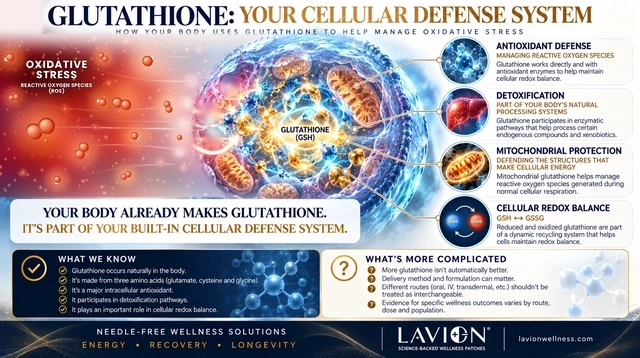
- Glutathione participates in antioxidant defense, redox balance, detoxification pathways and mitochondrial protection.
- Human supplementation studies have produced different results; formulation, dose, delivery route and duration matter.
- Established glutathione biology does not automatically prove that a specific product will detox the body, reverse aging or transform skin.
Your body has its own built-in antioxidant defense system—and glutathione is one of its most important players.
You have probably heard antioxidants associated with berries, green tea, vitamins and supplements. But one of the body’s most important antioxidants is not something humans discovered in a superfood. Your cells make it themselves.
It is called glutathione, often abbreviated GSH. Glutathione plays a central role in antioxidant defense, cellular redox balance and detoxification pathways. It also works with specialized enzymes to help cells manage reactive molecules produced through normal metabolism and environmental exposures.
That is why glutathione has become such a major topic in conversations surrounding wellness, healthy aging, recovery and longevity. But—as with peptides—the biology and the marketing are not always the same thing. Understanding glutathione starts with understanding what it actually does inside the body.
What Is Glutathione?
Glutathione is a small molecule made from three amino acids: glutamate, cysteine and glycine. That makes glutathione a tripeptide. It exists throughout the body and is particularly abundant inside cells, where its chemistry allows it to participate in antioxidant defense and numerous other cellular processes.
Glutathione exists primarily in two forms: GSH, or reduced glutathione, and GSSG, or oxidized glutathione. The relationship between these forms is part of the body’s dynamic redox system.
Rather than thinking of glutathione simply as a molecule that ‘removes toxins,’ it is more accurate to think of it as part of an interconnected cellular defense and recycling network. Your body does not just fight oxidative stress. It continually manages it. And glutathione is one of the major systems involved.
Why Is Glutathione So Important?
Every day, our cells carry out thousands of chemical reactions. Those reactions are essential to life, but normal metabolism can also generate highly reactive molecules, including reactive oxygen species, or ROS.
ROS are not automatically bad. At controlled levels, reactive oxygen species participate in normal cellular signaling. Problems can arise when the production of oxidants overwhelms the body’s ability to manage them. That imbalance is known as oxidative stress. Glutathione is one of the body’s central systems for maintaining that balance.
Four Major Roles of Glutathione
1. Antioxidant Defense
This is the role glutathione is best known for. Glutathione can interact directly with certain reactive molecules, but much of its antioxidant importance comes from working alongside enzymes.
One important example is glutathione peroxidase. These enzymes use reduced glutathione (GSH) to help process peroxides. During that process, GSH is converted into oxidized glutathione (GSSG). Another enzyme—glutathione reductase—converts GSSG back into GSH using NADPH.
That ability to move between reduced and oxidized states is one reason glutathione is so important to cellular antioxidant defense.
2. Oxidative Stress & Redox Balance
The term oxidative stress gets used constantly in wellness marketing. But it does not simply mean ‘free radicals are bad.’ Our bodies deliberately produce reactive oxygen species. They are involved in normal biological processes and cellular signaling. The goal is not to eliminate every oxidant. It is to maintain balance.
Glutathione participates in that balance by helping cells maintain an appropriate redox environment. That is why researchers frequently measure the ratio of GSH to GSSG when studying oxidative stress. Glutathione is better understood as part of a sophisticated regulatory system—not simply a sponge soaking up free radicals.
3. Detoxification
‘Detox’ may be one of the most overused words in wellness. But glutathione really does participate in the body’s biochemical detoxification systems. The important distinction is how.
Glutathione works with enzymes called glutathione S-transferases, or GSTs. These enzymes help attach glutathione to certain electrophilic compounds and metabolites, creating conjugates that cells can process and eliminate. Glutathione therefore participates in the body’s handling of both internally generated compounds and foreign substances, or xenobiotics.
That does not mean taking glutathione simply ‘flushes toxins’ from the body. Detoxification involves the liver, kidneys, enzymes and numerous interconnected metabolic pathways. Glutathione is an important participant in those systems—not a magic cleanse.
4. Mitochondrial Protection
There is an interesting connection here with MOTS-c. Mitochondria make cellular energy—but energy production also generates reactive oxygen species.
Glutathione is synthesized outside the mitochondria and transported into them. Once there, mitochondrial glutathione helps defend against respiration-associated reactive oxygen species and helps process lipid hydroperoxides and electrophilic compounds.
So while MOTS-c introduces us to mitochondrial communication, glutathione introduces another part of mitochondrial biology: cellular defense.
Why Do People Call Glutathione the ‘Master Antioxidant’?
You will frequently see glutathione called the ‘master antioxidant.’ That is a useful shorthand—but it is not an official biological classification.
What makes glutathione particularly important is its abundance inside cells and its involvement in multiple antioxidant systems. It can act directly as an antioxidant, serve as a cofactor for antioxidant enzymes and help regenerate and protect other cellular molecules. Rather than imagining one superhero antioxidant doing everything itself, think of glutathione as a central member of a much larger antioxidant network.
What Happens to Glutathione as We Age?
This is another reason glutathione receives so much attention in longevity research. Researchers have investigated changes in glutathione homeostasis in connection with aging and age-associated oxidative stress.
But that does not mean low glutathione is the single cause of aging—or that increasing glutathione reverses aging. Aging involves an enormous network of biological changes. Glutathione and redox biology are pieces of that much larger puzzle.
What About Glutathione for Skin?
Glutathione has also become extremely popular in beauty and skin-wellness conversations. Research has explored glutathione in relation to oxidative stress and pigmentation biology, which has driven interest in oral, topical and other forms of glutathione.
But evidence for specific cosmetic outcomes depends heavily on the formulation, route, dose, population and outcome being studied. That is another example of why it is important to distinguish what glutathione naturally does biologically from what a particular glutathione product has actually been demonstrated to do in humans.
Does Taking Glutathione Increase Glutathione Levels?
Here is where the science becomes more nuanced. Researchers have studied several strategies for influencing glutathione status, including direct glutathione supplementation and providing precursors the body uses to synthesize glutathione. Human studies of oral glutathione have not all produced the same results.
A small randomized controlled trial involving 40 healthy adults found that 1,000 mg of oral glutathione daily for four weeks did not significantly change glutathione measures compared with placebo. A later six-month randomized controlled trial involving 54 adults found that daily oral glutathione at 250 mg or 1,000 mg increased glutathione levels in several body compartments, with effects varying by dose, time and tissue measured.
A 2026 crossover trial involving 14 healthy adults found substantial differences in systemic glutathione exposure among different oral formulations, suggesting formulation itself may influence bioavailability. The authors emphasized that larger studies are still needed to establish longer-term physiological and clinical effects.
Glutathione Biology vs. Glutathione Benefits
| What is established about glutathione biology | What a specific product should not automatically be assumed to do |
|---|---|
| Occurs naturally throughout the human body | ‘Detox’ the entire body |
| Is made from glutamate, cysteine and glycine | Prevent disease or eliminate fatigue |
| Is a major intracellular antioxidant | Reverse aging |
| Works with glutathione-dependent enzymes | Improve athletic recovery |
| Participates in redox balance and detoxification pathways | Transform skin |
| Plays an important role within mitochondria | Produce the same effects regardless of delivery method |
Those are different questions requiring evidence for the specific intervention, dose, route and outcome. At LavION, we believe the biology is interesting enough without turning it into promises.
Does Glutathione Have to Mean Pills or IVs?
Glutathione is available through a growing number of wellness approaches. Consumers may encounter capsules, liquids, liposomal products, IVs, topicals and precursor supplements. Different delivery methods are not automatically interchangeable. Research involving one route should not simply be used as evidence for another.
That is particularly important with glutathione because studies suggest formulation and delivery can affect how glutathione behaves after administration. And that is where the delivery conversation becomes especially interesting.
A Different Approach to Wellness Delivery
LavION is not a traditional passive wellness patch. Our wearable incorporates iontophoresis technology, a sealed power source and two electrodes. Iontophoresis uses a mild electrical current to assist the movement of charged molecules across the skin.
The LavION wearable is designed for a 12-hour wear period, creating a different experience for consumers interested in incorporating goal-based wellness ingredients into their routines. Importantly, evidence involving oral or intravenous glutathione should not automatically be interpreted as evidence for transdermal delivery. Different delivery methods require their own evaluation. Not a sticker. A device. See how LavION works →
Meet RENEW: Featuring Glutathione
For consumers interested in glutathione and antioxidant wellness, RENEW brings glutathione into LavION’s needle-free wearable platform.
The Bottom Line
Glutathione is a central part of the body’s cellular defense network. Its roles in antioxidant enzyme systems, redox balance, detoxification pathways and mitochondrial protection are well established. What remains product-specific is whether a given supplement, formulation or delivery route meaningfully changes glutathione status or produces a particular health outcome.
That distinction lets us appreciate the science without turning a sophisticated biological system into a simple promise. The most useful question is not whether glutathione is important—it clearly is—but what evidence supports the exact product, dose, route and result being discussed.
References
- 1.Forman HJ, Zhang H, Rinna A. “Glutathione: overview of its protective roles, measurement, and biosynthesis.” Molecular Aspects of Medicine, 2009. View on PubMed
- 2.Allen J, Bradley RD. “Effects of oral glutathione supplementation on systemic oxidative stress biomarkers in human volunteers.” Journal of Alternative and Complementary Medicine, 2011. View on PubMed
- 3.Richie JP Jr, et al. “Randomized controlled trial of oral glutathione supplementation on body stores of glutathione.” European Journal of Nutrition, 2015. View on PubMed
- 4.Marí M, et al. “Mitochondrial glutathione, a key survival antioxidant.” Antioxidants & Redox Signaling, 2009. View on PubMed
Frequently asked questions
What is glutathione?
Glutathione is a tripeptide made from glutamate, cysteine and glycine. It is produced naturally in the body and is a major intracellular antioxidant involved in redox balance and other cellular processes.
Why is glutathione called the master antioxidant?
The phrase is informal shorthand for glutathione’s abundance inside cells and its central role in several antioxidant systems. It is not an official biological classification.
What are the main benefits of glutathione?
Glutathione’s established biological roles include antioxidant defense, cellular redox balance, participation in detoxification pathways and protection within mitochondria. These roles do not automatically prove specific benefits from every glutathione product.
What are GSH and GSSG?
GSH is reduced glutathione and GSSG is oxidized glutathione. Their relationship is part of a recycling system cells use to manage oxidative reactions and maintain redox balance.
Does glutathione detox the body?
Glutathione participates in biochemical detoxification pathways, including reactions involving glutathione S-transferases. But detoxification also depends on the liver, kidneys, enzymes and many interconnected pathways; glutathione is not a magic cleanse.
Does taking glutathione increase glutathione levels?
Human studies have produced different results. Evidence suggests that formulation, dose, duration, tissue measured and delivery route can all influence the outcome.
Is glutathione good for skin?
Glutathione has been studied in relation to oxidative stress and pigmentation biology, but cosmetic outcomes depend on the specific formulation, route, dose, population and outcome studied.
What is the connection between glutathione and mitochondria?
Glutathione is transported into mitochondria, where it participates in defense against reactive molecules associated with energy production and helps process lipid hydroperoxides and electrophilic compounds.
Are oral, IV and transdermal glutathione interchangeable?
No. Evidence from one delivery method should not automatically be applied to another. Each formulation and route requires its own evaluation.
Keep reading
This article offers general wellness education and does not replace medical advice. Statements about LavION+ products have not been evaluated by the FDA, and these products are not intended to diagnose, treat, cure, or prevent disease. Peptide orders include a clinician review before fulfillment. If you are pregnant, nursing, managing a condition, or taking medication, speak with your clinician. See our medical disclaimer.